
Home › Snake Safety Training › 4-Hour Wildlife Safety & Awareness Training

Working outdoors brings people into contact with wildlife, and while snakes are often the main concern, they are only part of the picture. Swooping magpies, possums sheltering in equipment, European wasp nests and injured animals on roadsides can all create situations that staff need to manage safely. For teams working in bushland, along waterways, on rural properties or in parks and reserves, understanding the animals they may encounter is an important part of being prepared.
Our four-hour Wildlife Safety & Awareness Training builds on our full snake and spider safety program to cover this broader range of workplace encounters. We help staff recognise potential hazards, understand animal behaviour and make informed decisions that protect both themselves and the wildlife around them. By connecting practical advice with situations they may face at work, the training gives participants a clearer understanding of how to avoid problems and respond when an encounter occurs.
At Black Snake Productions, this knowledge comes from years of caring for and working closely with a wide range of Australian wildlife, including the animals at our private zoo. We bring that experience into every session, explaining why animals behave as they do and how that behaviour can change when they are startled, injured or feel threatened. This helps staff apply what they have learned when a situation is unfamiliar and decide on a safe course of action.











Magpies and some other birds defend their nests in spring, usually from late winter to early summer. Swooping causes eye and head injuries, and it causes accidents when a worker on a mower, ladder or bike reacts suddenly. We cover how to recognise a nesting territory, how to plan work around it, and simple controls such as rerouting tasks, wearing hats and eyewear, and not running or waving arms.
Kangaroos are usually shy, but large males can be dangerous when cornered, injured or habituated to people. Teams working on golf courses, rural reserves and the urban fringe need to know how to read their body language, keep a safe distance and back away calmly. Kangaroos and wallabies are also a major vehicle hazard at dawn and dusk.
Wombats are strong and can charge if they feel threatened. Their burrows create trip and rollover hazards for people and machinery, and they are protected, so burrows cannot simply be filled in. We cover how to spot burrows and plan around them.
Possums, birds and other animals move into roof spaces, pole-top boxes, switchboards, meter boxes, pump sheds and parked equipment. Staff who open these spaces can be bitten, scratched or startled into a fall. We cover how to check before opening, how to give an animal a way out, and when to call a wildlife professional.
Bats in Australia can carry Australian bat lyssavirus. Only vaccinated, trained people should ever handle a bat, alive or dead. This is one of the most important messages for field teams, because the natural instinct is to help a bat that looks injured or caught in netting. We cover what to do instead and who to call.
European wasps nest in the ground, in walls and in pits, and they sting repeatedly when disturbed. Bees are common around water infrastructure and hollow trees. For staff with allergies, a sting can trigger anaphylaxis. We cover how to recognise nests, how to avoid disturbing them, and how stings fit into your first aid and emergency plans.
Deer are an increasing vehicle hazard in parts of Victoria, and foxes, feral cats and wild dogs may be encountered in some areas. We cover the risks these animals pose and how they differ from native wildlife in how you should respond.
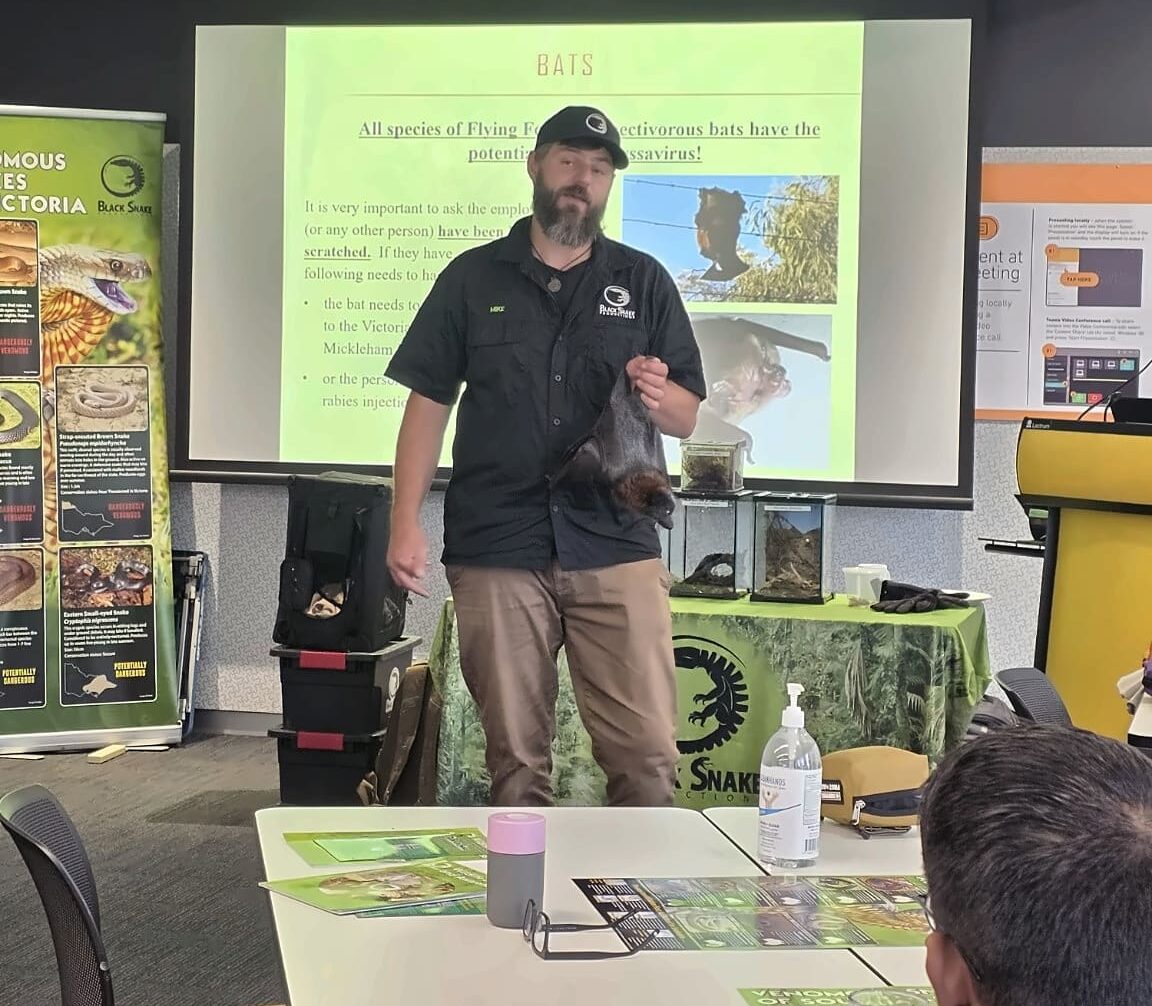
The session includes live venomous snake demonstrations inside our government-approved snake pit, alongside selected reptiles, birds, marsupials and invertebrates from our private zoo. We choose animals to suit your team's learning goals. Harmless reptiles, such as pythons and lizards, allow supervised interaction where appropriate.
Seeing animals up close helps staff understand that different animals need different responses. Participants learn when to give an animal space, when an encounter needs professional help, and how unnecessary intervention can increase risk for both people and wildlife.
Outdoor teams regularly find injured animals, especially along roads and in parks. Staff want to help, and that instinct is good, but handling injured wildlife can lead to bites, scratches, kicks and disease exposure. Our training covers basic wildlife rescue awareness: how to assess the situation from a safe distance, how to keep people and traffic clear, which animals should never be approached, and how to refer the animal to the right service.
In Victoria, injured wildlife can be reported to wildlife rescue services such as Wildlife Victoria.
Wildlife hazards change with the season, the weather, the time of day and the site. A good risk assessment reflects that. During the session we help your team think through:
We use examples from your own work, so the session produces practical ideas your supervisors can take straight into their pre-start checks and risk assessments.
The four-hour format leaves room for questions, practical activities and discussion of encounters your staff have already had. We work through realistic scenarios in small groups. For example: a worker bitten on a remote easement with no mobile signal, a snake found in a site lunchroom, a crew member stung multiple times who has a known allergy, or an injured kangaroo on a council road at dusk. Each group decides what to do, and the trainer walks through the safest response.
Scenario work is where training sticks. It turns a list of facts into decisions staff have already rehearsed, which makes a calm response far more likely on the day.
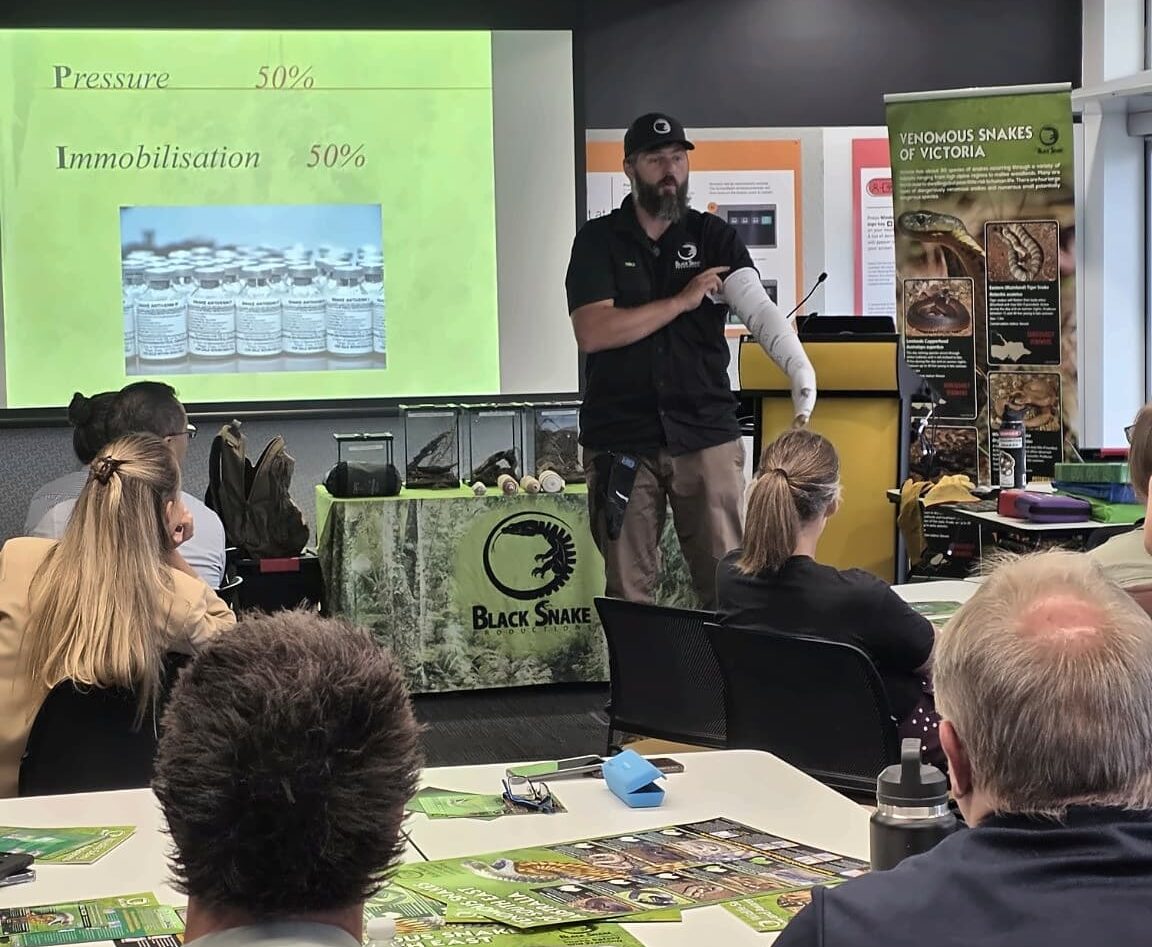
Every participant practises pressure immobilisation bandaging, the recommended first aid for bites from all Australian venomous snakes, using training bandages with pressure indicators. We also cover first aid for spider bites, which differs by species, and how stings and allergic reactions fit into your emergency plan.
For a step-by-step outline of the snakebite first aid we teach, see the 2-hour Snake & Spider Safety Training page.
For your organisation: supports your OHS/WHS hazard identification and risk control obligations, with practical input your supervisors can use in risk assessments and pre-start checks.
Reviewed by Michael Alexander, Founder and Lead Trainer (26+ years working with venomous snakes). Last reviewed: 5 November 2026.
See all options: snake safety training courses · Further reading: wildlife and snake safety training in Victoria
It includes everything in the 2-hour session, plus broader wildlife hazards, animals in buildings and equipment, injured wildlife, and more time for workplace scenarios.
We select reptiles, birds, marsupials and invertebrates to suit your team's work environment and learning goals.
No. It covers awareness, prevention and response. For capture and relocation, see our Snake Relocation & Handling courses.
Yes. Tell us where your staff work and the encounters they have had, and we build the scenarios around them.
Group size is tailored to your team. Tell us how many people need training when you request a quote.
© 2026 Black Snake Productions. All Rights Reserved | Website Design by Fox & Lee
